Every Man Should Dedicate 3 Months to His Fertility Before Trying to Conceive
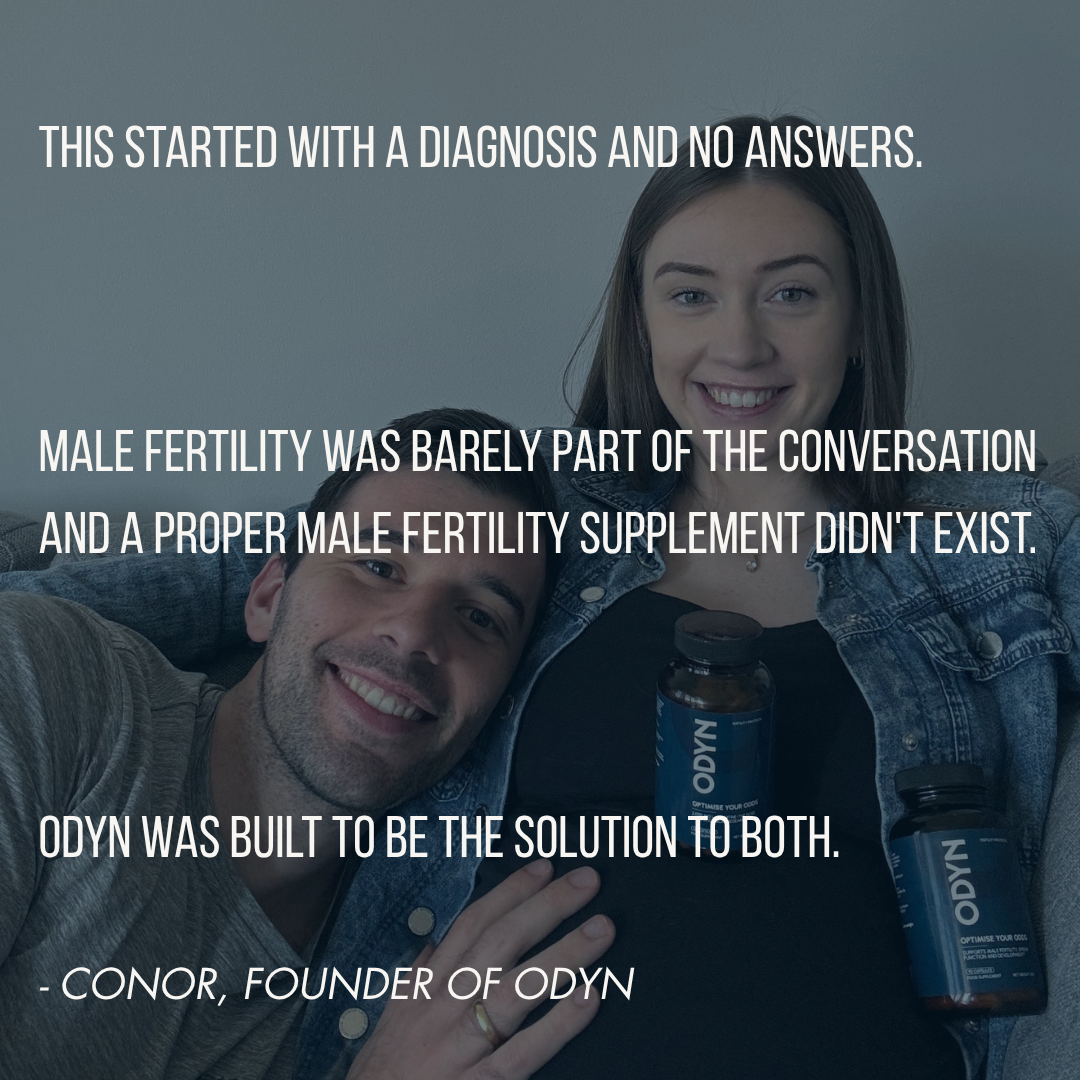
I'll be honest. Before my diagnosis, I never gave my fertility a second thought.
I assumed I was fine. I had no reason to think I wasn't. And like most men, my understanding of male fertility basically started and ended with "as long as I can perform during the ovulation window, I'm doing my bit."
That turned out to be very wrong.
One of the things that motivated me to build ODYN wasn't just wanting a better supplement. It was wanting to change the conversation: to make male fertility something men think about proactively, not reactively. This post is part of that and why three months of deliberate effort, before you even start trying, could make a real difference.
The "forever fertile" myth
Most men grow up with a very simple mental model of how male fertility works: as long as you can perform, you're fine. Unlike women, we don't even need to think of stuff like a "biological clock".
That's wrong on two levels.
First, male fertility does decline with age. It's less dramatic and less well-publicised than the female biological clock, but it's real. Sperm quality (count, motility, morphology, and DNA integrity) all decline gradually as men get older. A 2022 review found that fathers aged 40 to 44 had a 23% higher likelihood of contributing to a spontaneous miscarriage compared to younger fathers.
Second, the picture among men in general isn't great either. A 2017 study, found that sperm concentration among Western men declined by 52% between 1973 and 2011. Total sperm count dropped by 59%. A follow-up analysis in 2022 found the decline was continuing and accelerating globally.
That's not a small shift. That's a generation of men producing meaningfully less sperm than their fathers and grandfathers did, and most of them don't give it a second thought.
The causes are a mix of lifestyle factors that I've covered in more detail here and broader environmental factors.
The "Pass/Fail" dilemma of male fertility tests
For the relatively small number of men who do get tested, the conversation usually ends in one of two places.
Either they're told everything is fine. Or they're told there's a problem.
Both of those outcomes miss something important.
The "everything is fine" conclusion is based on whether your results sit above the WHO reference thresholds. But those thresholds have been revised downwards significantly over time and they represent the floor, not the ceiling.
For example, in 1992, the WHO required at least 30% normal-shaped sperm to be considered within the normal range. By 1999, that had dropped to 14%. By 2010, it had dropped again to just 4%. The bar for "normal" has been progressively lowered as average sperm quality has declined. If you are unsure of what sperm parameters are, you can check out another post I wrote here.
I've used this analogy before and I'll use it again. If 40% is the pass mark on an exam, technically a 41% is a pass. But none of us would go home proud of that result. That's essentially what "above the WHO threshold" means on a semen analysis. You've cleared a bar that keeps getting lowered - yes its good but not a reason to relax or not take action.
On the other side, I was made to feel that getting a result below threshold meant I was "infertile" and that IVF was my only realistic option. That wasn't accurate either. Male fertility isn't binary. It's not pass or fail. It sits on a spectrum, and for many men it's meaningfully improvable.
Why sperm quality matters for more than just getting pregnant
Sperm quality isn't just a factor in whether conception happens. It affects what happens after.
Miscarriage. Sperm DNA fragmentation (damage to the genetic material inside sperm) is increasingly recognised as a factor in pregnancy loss. One study calculated that the risk of miscarriage was 5.76 times higher in patients with high rates of sperm DNA damage compared to those with low rates.
Pregnancy complications. Sperm quality has been associated with higher rates of pre-eclampsia in the mother, preterm birth, and lower birth weight.
Child health. What's well-established is that sperm DNA integrity matters for healthy embryo development. Initial studies have also suggested potential links between sperm quality and longer-term health outcomes in children, but this is an area where the science is still developing.
The point isn't to alarm anyone. It's to be honest that sperm quality isn't just a fertility metric. It's a health metric. And it's one that gets almost no attention.
What men can actually do
The good news is that sperm quality is modifiable in the majority of cases. Sperm are constantly being produced. The full development cycle takes roughly 74 days. More on that here.
That means what you do over the next three months directly affects the sperm you produce at the end of it. Three months of consistent effort across the right areas can genuinely shift things. Not guaranteed but they can make a meaningful difference.
Lifestyle. Heat, alcohol, smoking, poor sleep, and high stress all contribute to oxidative damage to sperm and reduced sperm quality. They're among the most impactful things you can change, and they're all within your control.
Nutrition. Sperm production is nutritionally demanding. Zinc, folate, selenium, vitamin D, CoQ10, and antioxidants like vitamins C and E all appear consistently in the research on sperm health.
Supplementation. Supplements work best alongside lifestyle changes, not instead of them. Yes, I believe the ODYN Male Fertility Supplement can make a meaningul difference, but its best taken in combination with lifestyle changes.
What needs to change
Male fertility needs to stop being something men only think about when something has gone wrong.
It should be a normal part of men's health. Talked about openly rather than treated as a source of shame.
When I started being honest about my own experience, I was surprised by how many men either had concerns themselves or knew someone who did.
Three months. That's all.
Not just men who've had a difficult result but every man who's thinking about starting a family. Tested or not. Diagnosis or no diagnosis. It doesn't need to be a permanent overhaul.
Just three months dedicated to making small consistent changes that improve male fertility - and that could make a real difference for you, your partner, and your future child.
Key Takeaways
- Male fertility declines with age
- Sperm counts among Western men have dropped by over 50% since the 1970s, with no sign of levelling off
- WHO reference thresholds for semen analysis have been lowered multiple times and represent a floor, not a target
- Poor sperm quality is linked to higher miscarriage risk, pregnancy complications, and emerging evidence on child health outcomes
- Sperm take 74 days to develop, meaning a 90-day commitment is such a valuable window for improvement
- Lifestyle, nutrition, and targeted supplementation are all modifiable factors with meaningful evidence behind them
Where ODYN fits
ODYN exists because I couldn't find what I needed when I needed it. There was no supplement built around how sperm actually develop, with the right ingredients at doses that actually meant something.
The ODYN Fertility Protocol is built around that 90-day window. Ten ingredients, clinically dosed, designed to support sperm health as a process rather than a quick fix.
No filler. No label-padding. No promises of overnight change.
If more men committed three months to this before trying to conceive, I genuinely believe it would change outcomes. That's why ODYN exists.
Explore the ODYN Fertility Protocol
A final word
I'm not a doctor. I'm a man who got a difficult diagnosis, did a lot of research, and decided to do something about it.
The conversation around male fertility is changing. Slowly, but it is. More men are asking questions. More couples are treating conception as a shared responsibility from the start, not a problem to diagnose after the fact.
Frequently Asked Questions
Does male fertility actually decline with age? Yes. Sperm quality - count, motility, morphology, and DNA integrity - all decline gradually with age. The decline isn't as sharp or as well-publicised as the female biological clock, but it's real and it has measurable effects on conception rates, miscarriage risk, and pregnancy outcomes.
Why have WHO thresholds for semen analysis been lowered over time? The thresholds are based on the 5th centile of semen parameters in fertile men. In other words, what the bottom 5% of men who successfully conceived look like. As average sperm quality in the population has declined, the threshold has moved with it. The 1992 morphology threshold was 30% normal forms. By 2010 it was 4%. Passing the current threshold means being above the bottom 5% of a population with declining average fertility.
Does sperm quality affect miscarriage risk? Yes. Sperm DNA fragmentation is increasingly recognised as a factor in pregnancy loss. This is separate from the parameters measured in a standard semen analysis, which is why it often goes undetected.
How long does it take to improve sperm quality? Sperm take roughly 74 days to develop from start to finish, so meaningful improvements typically take two to three months to show up in results. This is why committing to lifestyle and nutritional changes at least 90 days before trying to conceive makes practical sense.
What are the most impactful things a man can do? The areas with the most consistent evidence: reducing alcohol and eliminating smoking, managing heat exposure (laptops, saunas, tight underwear), improving sleep, eating in a way that supports key micronutrients (zinc, folate, selenium, vitamin D, CoQ10, antioxidants), and reducing oxidative stress through both lifestyle and supplementation. None of these are complicated. They just require consistency over three months.